Svensk version
Citizens' assemblies as a method to revitalize democracy
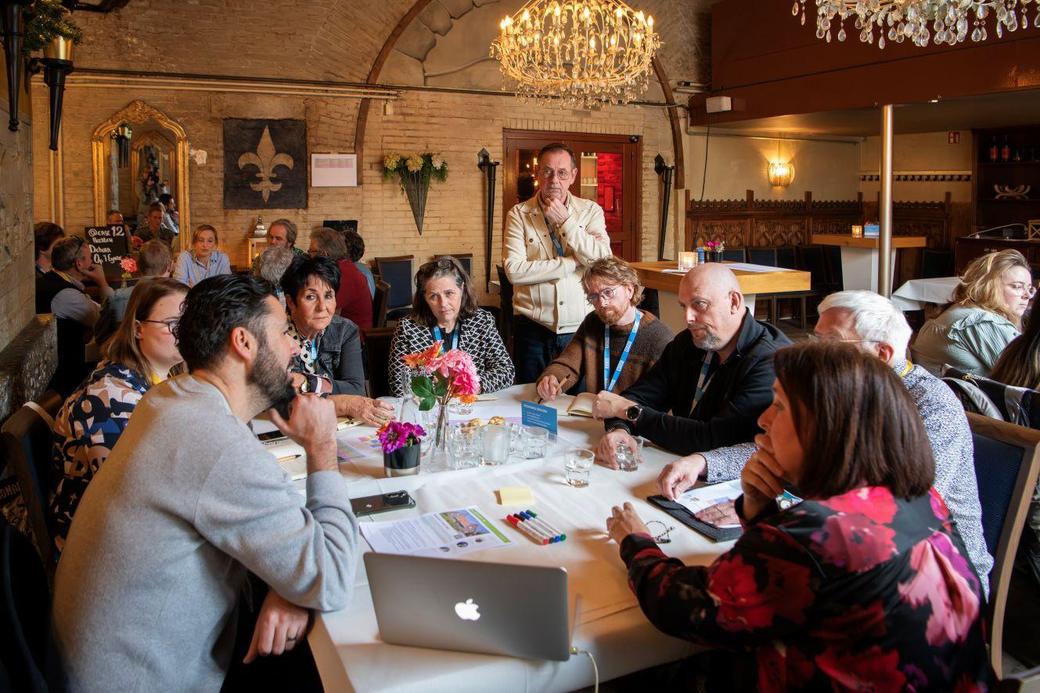
Citizens’ assembly in Heerlen, The Netherlands. Photo credits: Sirella Dieteren
A citizens' assembly is a group of randomly selected people, representative of the population, who discuss specific social issues to provide decision-makers with information. It is a democratic method that aims to increase influence in political decisions by allowing ordinary people to delve into issues in depth and propose solutions. Assembly members are given resources, expert help and time to learn about the subject before formulating recommendations.
Why citizens' assemblies? Representative democracy today has problems dealing with challenging issues. The debate in political parliaments often takes place on a superficial, polarized level where people do not listen to each other because positions have already been locked in, often under the influence of lobbyists who have already limited perspectives. To break deadlocks and create more well-founded and popularly-rooted political decisions, the method can be used by both states and municipalities, or even at the EU and UN levels.
Example of a citizens' assembly: Ireland, on the abortion issue - Until 2018, Ireland had one of the world's strictest abortion laws. The consequences were that women risked prison sentences and thousands traveled abroad annually to terminate pregnancies. A citizens' assembly with 99 participants was a decisive factor in breaking the political deadlock. After in-depth discussions and expert testimony over five weekends spread over 18 months, the assembly recommended in 2017 that abortion should be allowed without requiring special reasons. This led to a referendum in May 2018 where 66% voted to repeal the abortion ban, which then became law via a parliamentary decision.
Shortcomings with Citizens' assemblies
- Citizens' assemblies' proposals can often be
watered down or voted down by the political parliaments.
- Elected politicians may be reluctant to implement citizens' assemblies if they
believe they disrupt or weaken normal representative democracy.
Show/hide More about Citizens' Assemblies
More examples of citizens' assemblies
- France, on the climate
France implemented a citizens' assembly for the climate that ran between 2019 and 2020. 150 randomly selected citizens were tasked with proposing measures to reduce the country's emissions by at least 40% by 2030. The assembly was established by President Macron as a way to better anchor the country's climate policy, after his attempts to raise fuel prices were met with resistance from the yellow vests. The assembly delivered extensive proposals, including proposals for referendums and to write the climate fight into the constitution. However, many proposals were watered down or voted down by parliament. The assembly process itself was nevertheless valuable in reaching out and engaging citizens and the media in discussions on climate policy.
- Sweden's National Citizens' Assembly on Climate
The assembly was initiated by researchers and was implemented in the spring of 2024 with 60 participants who met on nine occasions. The main question was "How should we in Sweden reduce climate emissions?". They focused on transport emissions and delivered 22 action proposals. However, the right-wing Tidö government showed no interest in the proposals.
Examples of local citizens' assemblies
- Gothenburg held a citizens' assembly on climate in 2024.
- Malmö, Borås and Sollefteå conducted local climate assemblies in 2024 under the leadership of Klimatriksdagen, which also documented the method in a handbook that can be downloaded and used by other municipalities.
- Paris has had a permanent citizens' assembly since 2021 that has addressed various social problems, such as homelessness.
Sources/reading tips
-
Citizens' assembly for Participation in Environmental and Climate Issues - City of Gothenburg
-
Project: Climate Council - Climate Parliament (Projekt: Klimatrådslag - Klimatriksdagen)
- Erika Bjerström's book "Democracy Dies in the Heat", the final chapter "A Fairer Way" which addresses citizens' assemblies.
Next: Wars, the arms race and the UN crisis as a democracy problem
Up

 THEME DEMOCRACY CRISIS
 Democratic renovation for a sustainable future
 Ancient Democracy - a protection against violence, concentration of power and corruption
 Wars, arms race and UN crisis
 Pensions and the financial system
 Knowledge deficit and media power
 Climate crisis
 Artificial Intelligence and internet addiction
 Summary - democratic renovation